
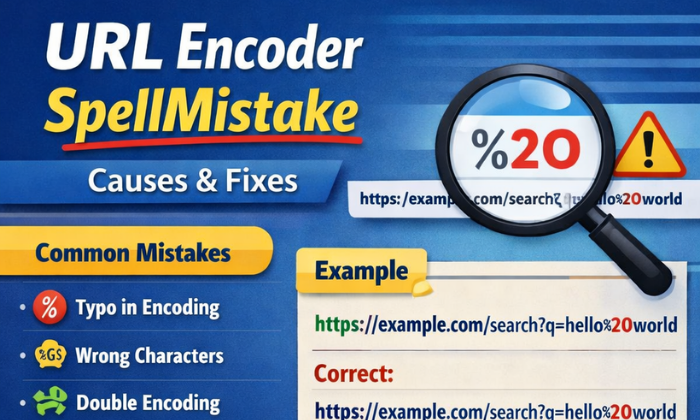
Any typo could cause misuse in the area of websites, Internet marketing, or wherever a person is employed. They perceive a URL encoder spell mistake here and there. It might seem like a small mistake, but issues in robots.txt can impact your site, search engine crawling indexation, and even a negative experience for users.So if you have ever copied a link somewhere and saw symbols such as %20, %2F or %3A then you have already seen URL encoding. A URL Encoder Spellmistake can break links, confuse your users, and decrease your website credibility, whilst URL encoding is an important technique that helps browsers interpret special characters.
This blog explains what URL encoder is, why URL encoding spelt wrongly occurs, how they can affect the websites and SEO and, most importantly, how you can fix as well as prevent them.
What Is a URL Encoder Spellmistake?
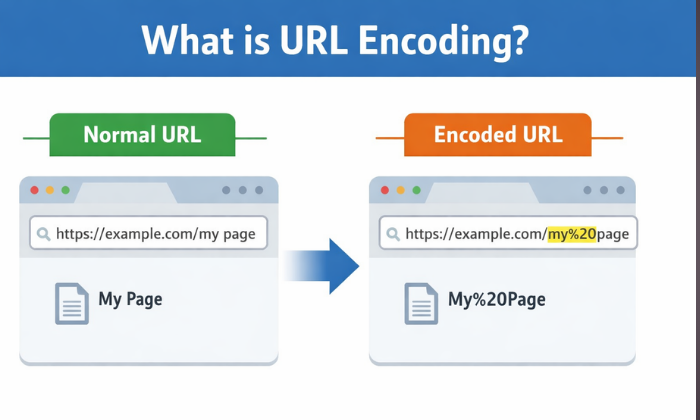
This is a tool that transforms your URL so that the characters in the URL are safe for any internet transfer.
The second is excessive use of special characters in URLs. If there are spaces, symbols, or special characters in an address, they will need to be encoded in a permissible format.
For example:
- Space becomes %20
- / becomes %3A
- : becomes %2F
This means that servers and browsers will interpret the address correctly.
But when a user does a spell mistake in the URL Encoder Spellmistake, the final string residing in the web browser becomes invalid or corrupted and it gives error in opening the page.
Common URL Encoded Characters
What Causes Mistakes in URL Encoder Spell
A URL encoder typo is often because of human error, the incorrect tools, or simply misunderstanding how the encoding works. So, here are some typical failures.
1. Typing Errors
Typographical Errors The most common cause of this is simply typing errors. Working out how to violate. For example the URL encodings for the space character is %20 but when doing the URL enter it manually they may type %2o or be confused between O and 0.
A small variation in encoded characters can drastically change the functioning of a URL.
2. Misunderstanding Encoding Rules
People believe that encoding is replacing text as in normal. However, URL Encoder Spellmistake has certain rules due to ASCII values.
If we do not understand these rules, all we do is accidentally create a URL Encoder Spellmistake and create invalid URLs.
3. Copy-Paste Issues
Bad copy – When copying URLs from documents or emails, additional spaces, and hidden characters are added. These characters can get encoded incorrectly then.
This leads to broken links or redirects.
4. Using Unreliable Tools
Not every tool designed for online encoding is infallible. Others might handle character encoding incorrectly or not manage elaborate URLs. URL Encoder Spellmistake creates a URL encoder typographical error that no user sees.
5. Manual Editing of Encoded URLs
During some debugging or testing attempts, Developers edit the encoded URL manually. If they have to change even one character, the whole URL might break.
Common URL Encoded Characters
| Character | Encoded Form | Example Use |
| Space | %20 | my%20page |
| / | %2F | folder%2Ffile |
| : | %3A | https%3A |
| ? | %3F | search%3Fq=test |
| & | %26 | name%26age |
How Spelling Mistakes By URL Encoder Spellmistake
It is a very devastating spell mistake of URL encoder that hardly anybody accounts it as a mistake. However, in reality it can affect many areas of a website.
Broken Links
If the characters are wrong, encoded, the browsers cannot read the URL. This frequently results in 404s or pages that won’t load.
Users can feel annoyed by the broken links and it gives your website an unprofessional look.
Poor User Experience
Links are expected to work fast by users. If they hit a link and it does not go through on account of a URL encoder spelling mistake, they may leave your webpage right away.
This results in increased bounce rates and less engagement.
SEO Problems
Crawlers also use URLs to navigate to pages to index them for Search Engines. Search engines may: as a result of if an URL Encoder Spellmistake has an encoding mistake
Fail to crawl the page
Index duplicate URLs
Ignore the page completely
But this can damage the site search ranking over time.
Tracking Errors
In turn, the tracking parameters in the encoded URLs in many marketing campaigns were created to track users. If there is a URL encoder spell mistake, then these parameters will break which are not tracked by various web analytics tools.That will make it difficult to track campaign performance.
How to Correct Spell Mistakes of URL Encoder
The good news is if you know the spelling mistake URL encoder, the fix is typically straightforward.
Use Trusted URL Encoder Spellmistake Tools
Encode with confidence Never convert manually! Always use the latest encoding tools Good tools convert characters automatically so there is less room for error.
Validate URLs Before Publishing
Test out the links in a browser before putting them on your website. As per checking that they are loading correctly and that they all redirect to the right place.
Check for Double Encoding
If, on the other hand, the URL looks way too long, or contains %25 then it is likely that it is double-encoded. Try decoding it and see if the link works.
Review Website Logs
Encoding errors are frequently uncoverable within server logs. If the links lead to broken addresses, logs may contain malformatted encoded URLs.
Use Developer Tools
The developer tools of modern browsers allow you to inspect requests and encoded URLs. These tools can help identify a URL encoder spell mistake quickly.
Read Also:Ivan Cornejo: Everything You Need To Know|Madison Beer Age, Height, Net Worth
Final Thoughts
You might think that a URL Encoder Spellmistake error is such a minor technicality, but its reach can be quite vast. But those basic mistakes can snatch many hurdles in web service such as broken links, lousy user experience, SEO problem, lost analytics data, and so on to the owner.
The silver lining is that most encoding errors are fairly simple to avoid. Utilizing trustworthy tools, not making manual adjustments, and constantly testing links will keep your links up to date and operational.
In the fast-paced realm of digital, the smallest detail, such as URL encoding, can make all the difference. That extra few seconds spent checking your URLs today saves hours of troubleshooting tomorrow.
For those who run a website, blog, or some sort of online business, URL Encoder Spellmistake are an easy, yet highly-effective way to preserve a smooth, seamless, and professional-brand online identity.
FAQs Related to URL Encoder Spellmistake
Q1. URL Encoder Spellmistake – what’s that?
A URL encoder typo occurs when encoded characters in a URL are miswritten or misformated. URL encoding transforms special characters into a format readable by the browser (ex. spaces become %20).
Q2. What Is URL Encoder Spellmistake and Why Is It Important for Websites?
This is where URL Encoder Spellmistake, or percent encoding, comes into play: web addresses can only contain a specific subset of characters. URLs are not meant to have spaces symbols and special characters, so these characters must be encoded so the browser and server .
Q3. Spelling mistake in an URL encoder and its effect on SEO
SEO is negatively affected by a URL encoder misspelling through multiple channels. So search engines may not be able to crawl the page correctly, they may see the wrong URL as a new page, or they may ignore it altogether. This may result in duplicate pages, difficulties in crawl, or decrease in search rankings.
Q4. What are the types of URL encoding mistakes?
Here are a few common URL encoding missteps:
- Use %2o instead of %20 for spaces
- Double encoding characters like %2520
- Leaving spaces unencoded in URLs
- Adding unnecessary encoded symbols
- And even trivial mistakes such as mistaking a letter O to the number 0, can lead to issues.
Q5. How do I know if I made a mistake encoding my URL?
Testing the URL in a browser or using an online URL decoder is the right way to check for encoding errors. The characters may be encoded incorrectly if the page throws an error or does not load properly. Developer tools and website audit tools can also detect encoding issues.
Q6. How do I correct a misspelled URL encoder?
Thus, you need to decode it first and then re-encode using some legitimate URL encoding tools in the case to get rid of a URL encoder spell bug. Edit encoded characters only if you know the encoding format completely.
Q7. What can I do to avoid such URL encoding issues in the future?
The most effective way to avoid errors is by using a tool or CMS which automatically handles URL encoding for you. Simplifying URLs by limiting the use of special characters, and testing links from time to time will also mitigate the risk of encoding errors.