
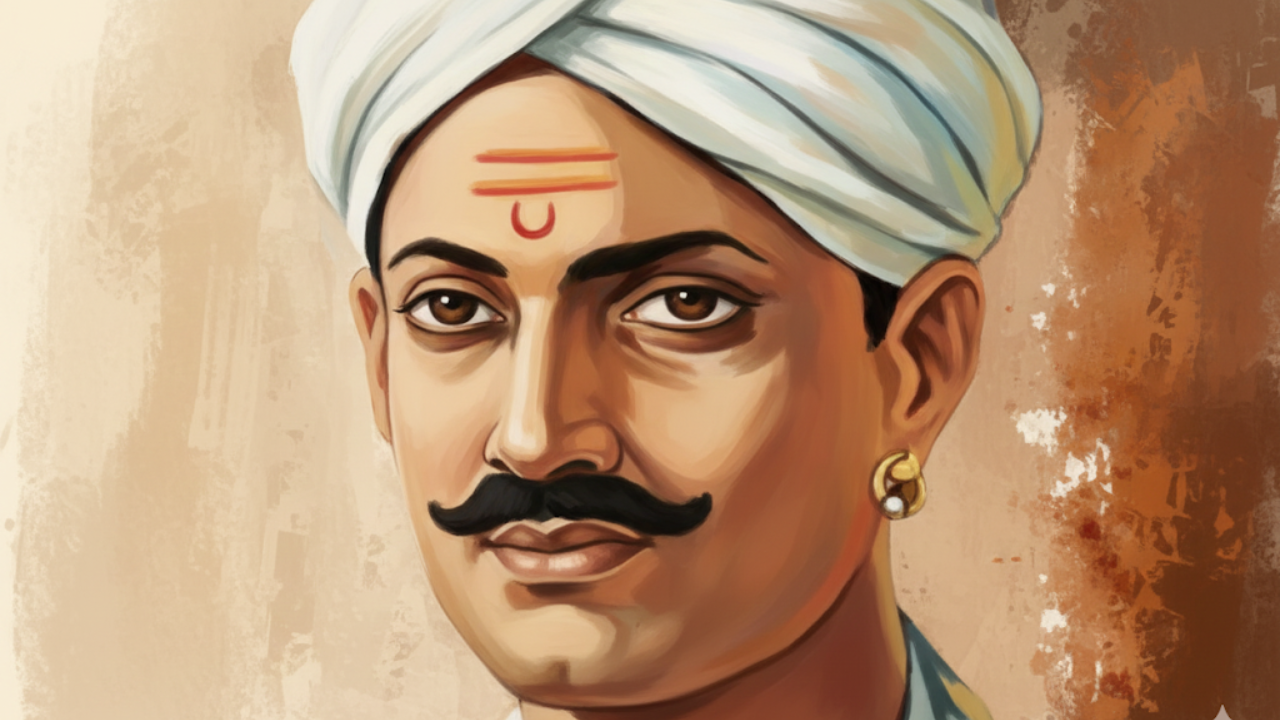
India began its Sisyphean battle against foreign domination long ago, but perhaps no event impacted the Indian story as prominently as the Revolt of 1857. The uprising is often referred to as the first war of independence in India, which rattled the British rule to its core and awoke a national identity among the masses. And among those who have dedicated themselves to this great history, there is, of course, one name which still has a lasting association with courage, defiance, and sacrifice. What he did may not have been on a large scale, but it sparked a fire that spread across most of northern and central India.
An understanding of Mangal Pandey and his role in the Revolt of 1857 is important in decoding how organised resistance to colonial rule gained acceptance. He didn’t command armies or reign over the kingdoms, but his fearless defiance emboldened soldiers and citizens alike. One of the bravest revolutionaries of the Subcontinent, here is an article covering his early life, background, family, and the circumstances which led him to rebel, what he did at Barrackpore and how he was tried and executed and then to be never forgotten from Indian History.
Early Life and Background
Mangal Pandey was born in 1827 in a small village, Nagwa, in Ballia district of modern-day Uttar Pradesh. Born to a Brahmin family, who traditionally elevated learning, self-discipline and religious ritual. He grew up in the Indian culture, her background was wholly in the Indian tradition of ways, and therefore, you can see that it is a rightful evergreen set of values.
However, the first half of the nineteenth century was a time of major social and economic transformation in rural India brought about by the expansion of British power. On the one hand, it disrupted traditional livelihoods, changed the system of land revenue, and created a conflict for the loyalty of Indian soldiers working in the British Army between their employers and their religion and tradition. Seeing this around himself, Mangal Pandey grew up with (No — never get me wrong, He was not believing himself to be a god in the first place) an image of the Indian masses, who were not only unhappy and frightened around the British Empire, but also were completely subjugated and being treated more than slaves in their own right land.
He enlisted in the Bengal Army, then part of the British East India Company, when he was just sixteen years old. The mainstay of the Company’s military power was Indian soldiers called sepoys. Though subjected to harsh training and strict discipline, these soldiers were nevertheless discriminated against because of their race, received lesser pay, and were less likely to move up the ranks.
The life of a Sepoy in the Bengal army
The British maintained three presidencies, of which the Bengal Army was one, the other two being the Madras and Bombay armies. Though many sepoys were recruited from upper-caste Hindu communities, recruits were drawn from all parts and classes of society. To win their allegiance, their religion and traditions were initially treated with respect.
But just as the British were the farthest thing from the top of your mind on the practice, British policies started to shift decades later. Indian soldiers were worried by social legislation, missionary work and administrative measures. Some sepoys were also scared that the British Government wanted to meddle with their religion, converting them to Christianity. This fear was exacerbated by rumours and misunderstandings, and a growing distrust.
Mangal Pandey was a sepoy in the 34th Bengal Native Infantry and was posted in Barrackpore, near Calcutta (now Kolkata). To all appearances, in fact, he was a disciplined soldier. But, like many of his fellow sepoys, he became increasingly discontented with British policies and British attitude towards Indian soldiers.
Also Read: QuillBot AI
Causes of the Revolt of 1857
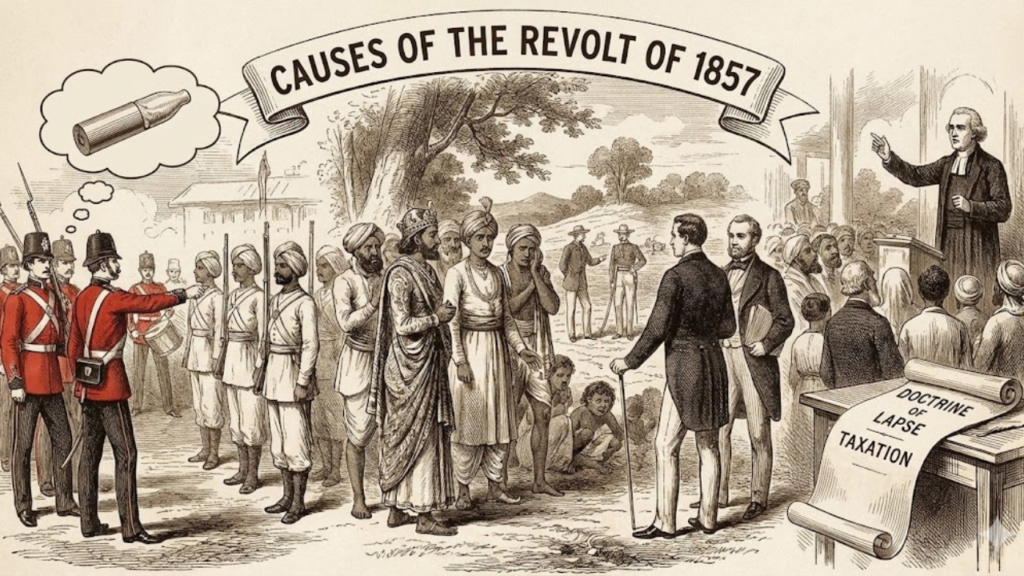
Before delving into Mangal Pandey’s contributions during the Revolt of 1857, it is essential to understand the general background of the Revolt of 1857. The rebellion was not spontaneous: the last straw, but rather the culmination of 30 years of grievances.
1. Political Causes
The history of British Aggression, which resulted in the annexation of Indian states, Indian monarchs, and existing political systems were torn down. This created bitterness among princes, nobles, and soldiers who had formerly served Indian kingdoms.
2. Economic Causes
Economic Policies sucked the wealth of India and destroyed Indian Industries by the British government. Widespread poverty was characterised by heavy taxation, the exploitative system of land revenue and the fall of handicrafts. These economic hardships hit the Sepoys hard, as they were often men from peasant families.
3. Social and Religious Causes
British social reforms, though couched in the rhetoric of political liberation, were seen as meddlesome. Suspicion arose due to laws that disrupted traditional practices. Then there were the activities of Christian missionaries: an added fear factor that Indian religions were under siege.
4. Military Grievances
Soldiers of the Hindustan army also discriminated between promotions and pay. They were dispatched overseas on missions without proper allowances, whilst breaching religious tenets about sailing across oceans. The sepoys, created increasingly discontent and furious by these grievances,
The Cartridge Controversy
The introduction of the Enfield rifle was one of the immediate sparks of the revolt. Word has it that this rifle had the cartridges smeared in animal fat from cows and pigs. The cartridge was loaded into the rifle after the soldiers had bitten off its tip.
Hindu soldiers cannot eat cow the way Muslim soldiers cannot eat pig. The cartridges were allegedly coated with animal fat, which incensed sepoys. The rumours were denied by British officials, but their assurances had arrived too late to restore confidence.
Like a lot of others, Mangal Pandey believed that the usage of these cartridges was a planned effort to contaminate Indian soldiers and get rid of their religion. This faith was the primary motivator behind his acting out in rebellion.
The Incident at Barrackpore
Mangal Pandey revolted openly against British rule at the Barrackpore cantonment on 29 March 1857. This is one of the earliest and most dramatic acts of the Revolt of 1857 and is one of the events regarded in hindsight as starting the Revolt of 1857.
He railed against British officers at the parade ground and incited side-by-side sepoys to revolt against the oppressors. He told them to reject the cartridges and fight back against the British. Such open rebellion was rare, and suffered instant and often gruesome punishment, but his was unambiguous and unprecedented.
Though a good many sepoys felt as he did, most were reluctant to join him straight away for fear of repercussions. He was arrested after a failed suicide attempt, but British officers soon brought him under control. The British authorities were stunned and realised the extent to which the agitation in the Indian army had gone.
Trial and Execution
After he was arrested, Mangal Pandey was subjected to a court-martial. In a desire for all other would-be rebels to take up their work boots, the Brits were eager to set an example with him. He was quickly tried and convicted of mutiny and assault on superior officers.
The verdict might have come as anticipated, though there was some sympathy from Indian soldiers and civilians. He was hanged on 8 April 1857 at Barrackpore. His regiment was subsequently disbanded, with those suspected of disloyalty receiving severe punishments.
The British were anticipating that his execution would stymie all opposition; in fact, the opposite occurred. Tales of his courage and sacrifice spread quickly, stirring others to pick up arms against colonial rule.
The Revolt of 1857 Intensifies Across India
A month passed after his execution, and full-scale mutiny commenced in Meerut, Delhi, Kanpur, Lucknow and elsewhere. Indians joined hands neither as Indian soldiers nor civilians against British rule.
Rani Lakshmibai, Bahadur Shah Zafar, and Kunwar Singh were some of the key leaders of the revolt against British rule. These leaders had diverse backgrounds, but they all sought an end to foreign rule.
The revolt is considered to have begun with the actions of Mangal Pandey. He stood up to British authority, proving that it could be resisted even when outmatched.
British Response to the Revolt of 1857
The Revolt of 1857 was crushed brutally. Thousands of Indians were murdered, and villages were wiped out. But the insurrection ultimately compelled the British government to reconsider its approach.
The British Crown took over India, directly governing the subcontinent as its colony in 1858, suspending the reign of the British East India Company. New administrative and military reforms were implemented, and tensions were minimised by the protection of religion. Despite British rule surviving the revolt, it was transformed by the experience.
Historical Significance of Mangal Pandey
In Indian history, Mangal Pandey has a special place. He was a run-of-the-mill foot soldier, not a king or a general, and through acts of personal bravery, became a national icon. It exposed the widespread discontent among Indian sepoys and the vulnerability of British rule.
Historians have discussed whether he was acting alone or as part of a broader conspiracy. Whatever the truth of this debate, his impact is undeniable. He proved that you could start a resistance with a single act & moral conviction.
Mangal Pandey in Indian Memory and Culture
Mangal Pandey has been immortalised in textbooks, folk tales, literary works and films over the years. Depicted as an unflinching patriot who lost his life serving the honour and liberty of the nation.
His tale has not only inspired generations of Indians but is also taught as a demonstration of bravery and overcoming powers. Throughout India, streets, schools, and institutions carry his name, evidence of the abiding esteem in which his sacrifice is held.
Conclusion
Subjects of the Ruling classes have little knowledge of Rulers or Revolutions. Nonetheless, Mangal Pandey was hugely significant in the Revolt of 1857, but he was not a ruler or a revolutionary leader. He made a conscious decision to rise above the aura of fear and scepticism hovering the Indian army of that period. That defiance of his at Barrackpore proved to be a catalyst in Indian resentment towards British Rule.
Although 1857 provided no immediate freedom, it sowed its seed to get rid of the British Raj in the coming years. The sacrifice of Mangal Pandey awakened the countrymen and showed that one of the first steps of freedom is to be fearless.
Remembering him and what he represented is paying tribute not just to a man but to the spirit of resistance that would finally lead India to freedom.
Mangal Pandey – Frequently Asked Questions (FAQs)
Q.1 How is Mangal Pandey an Important Person in Indian History?
He is most well known for openly defying British officers in March 1857, which sparked a widespread uprising throughout northern India.
Q.2 When was Mangal Pandey born?
He was born in 1827 at Nagwa village, now in Ballia district of UP.
Q.3 In which army was Mangal Pandey a soldier?
Mangal Pandey was working at the time under the British East India Company in the 34th Bengal Native Infantry.
Q.4 What did Mangal Pandey do in the Revolt of 1857?
His assault on British soldiers at Barrackpore is regarded as one of the first incidents of military uprising which triggered the Revolt of 1857.
Q.5 What incident pushed Mangal Pandey to revolt?
The Mangal Rebellion was sparked by the controversy over Enfield rifle cartridges rumoured to be greased with cow and pig fat, which deeply offended religious sentiments.
Q.6 In which part of India did Mangal Pandey revolt against the British?
His revolt was at the Barrackpore cantonment, near Calcutta (Calcutta now is called Kolkata).
Q.7 Did any soldiers support Mangal Pandey during the revolt?
Though a majority of the sepoys were sympathetic to him, as long as the punishment was at hand, no one would dare come to his aid.
Q.8 When was Mangal Pandey executed?
He was hanged on 8 April 1857 at Barrackpore.